Honestly, the redesign was nice, but the inquiry form is what changed our day-to-day. It asks for pickup location, rental dates and vehicle class before anything is sent, which is the information we used to chase by email. The first message is usually enough to act on now.
A website that fills your lot, not just your inbox
A managed, custom-coded website for car and van rental companies: live in 7 days, 90+ PageSpeed, weekly rate and fleet updates, researched articles and hosting included, from one monthly fee.
Live in 7 days on Solo Lot. $697 build fee invoiced only after launch.
Preview: your booking tool
Vehicle class
CompactSUVCargo van
Example data for illustration. Requests route into your CRM, not ours.
One page per lot
Every location ranks on its own.
One page per class
Economy to cargo van, each with its own page.
Nothing itemised
Domain, hosting, updates and articles, all in one monthly fee.
Built for every corner of a rental operation
Economy and compactSUV and crossoverCargo and passenger vanBox truckLuxury and exoticOne way and outstationAirport and off airportPassenger van and minibus
Honestly, the redesign was nice, but the inquiry form is what changed our day-to-day. It asks for pickup location, rental dates and vehicle class before anything is sent, which is the information we used to chase by email. The first message is usually enough to act on now.

7 days
to launch on Solo Lot
90+
Google PageSpeed guaranteed
5 / month
revisions included
$697
$697 build fee, invoiced after launch
What usually stalls a rental company’s bookings
Five problems we see on almost every independent rental site before it is rebuilt, and what each one actually costs.
One shared "our fleet" page instead of a page per vehicle class
The site cannot rank for "cargo van rental" or "SUV rental" specifically, so it competes for nothing and renters searching for a class land on a competitor's dedicated page instead.
No dedicated page for each pickup location
A search for a specific lot or counter finds a map pin and nothing else, and a multi-location operator loses local search entirely to single-location competitors with better pages.
Booking requests only come in by phone
Every call that goes unanswered after hours or during a busy counter is a booking that goes to whichever competitor answered first.
A slow site on the exact device most renters use
A renter comparing lots on a phone in a terminal will not wait for a slow page. A slow load is a lost booking before the fleet is even seen.
A site built once and never updated since
Rates go stale, a closed location still shows as open, and a vehicle class no longer offered keeps generating enquiries nobody can fulfil.
What it costs to leave it as it is
Nothing about an out-of-date rental website fails loudly. It costs bookings you never hear about, one search at a time, which is exactly why it stays at the bottom of the list for another season.
- A renter opens your site at 11pm to hold a van for SaturdayThere is no way to ask for it, so they open the next tab and hold one there instead.
- Someone searches the vehicle class by name, not your business nameA competitor with a page for that exact class takes the click, and you never see that search happen.
- A renter lands on a slow page on cell data at the terminalThey leave before the fleet renders. You paid for that visit if it came from an ad.
- The site still lists a lot you closed or a class you retiredYour counter staff spend the morning apologising for something the website promised.
- A month passes with nothing new publishedSearch engines keep ranking the operators who did publish, and the gap compounds quietly.
None of this needs a new marketing strategy. It needs the pages a renter is already searching for, kept current by somebody whose job that is.
What replaces it
A page for every vehicle class
Economy, SUV, cargo van and every class you rent gets its own page, its own copy and its own path into the booking form.
A page for every location
Address, hours, directions and the fleet on hand, for every lot or counter you run.
A booking tool that never sleeps
Requests route into your CRM the moment they are submitted, day or night.
Pages that open instantly
90+ PageSpeed guaranteed on the fleet and location pages renters actually load.
Weekly checks on rates and fleet text
Nothing goes stale. Wrong or outdated text is caught and corrected every week.
The pickup to return journey
A rental website is not judged on the homepage. It is judged at five moments in a renter's actual trip, and here is what it owes them at each one. Scroll to follow the trip.
1. Search
A dedicated page for the exact vehicle class and pickup location they searched, not a generic fleet page they have to dig through.
2. Booking request
A form that asks for pickup, return, dates and class in the order they are already thinking in, submitted in under a minute.
3. Pickup
Accurate hours, directions and shuttle information, so the lot they arrive at matches what the site told them.
4. The rental period
Mileage caps, deposit terms and policy pages answered in plain language, so a question does not require a hold-music call.
5. Return
A return address, hours and any drop fee that match exactly what was published when the booking was made.
What changes for the business, not just the website
- Booking requests arrive around the clock instead of only during counter hours.
- Each vehicle class and location competes for its own search instead of sharing one weak page.
- Rate and fleet text is checked weekly, so nothing goes stale between visits from you.
- Common questions get answered on the page, so your phone rings for bookings, not for explanations.

A revision is completed within 2 to 5 working days, whatever the size.
Not a queue. Not a ticket that sits for a week. A stated turnaround, every time.
Before and after
The same six things, on the sites we usually replace and on the ones we build.
- Vehicle classesBefore:One "our fleet" page listing every vehicle togetherAfter:A dedicated page for each class: economy, SUV, cargo van and more
- LocationsBefore:A single address buried in the footerAfter:A page per lot with hours, directions and the fleet on hand
- Booking requestsBefore:Phone only, missed after hoursAfter:A booking form that routes straight into your CRM, day or night
- One way rentalsBefore:Not mentioned, or a phone call required to askAfter:Its own page with supported routes and drop fee stated clearly
- Page speedBefore:A slow page-builder site on a phoneAfter:90+ PageSpeed guaranteed, on the pages renters actually load
- Rate and fleet textBefore:Updated once a year, if thatAfter:Checked and corrected every week as part of the plan
What is in every plan
A custom-coded website
Built for your fleet and locations, not assembled from a page-builder plugin stack.
Booking request tool
Pickup, return, dates and class, routed straight into your CRM.
A free domain
Registered in your name, or point the one you already own.
Managed hosting
Cloudflare hosting with SSL, CDN and DDoS protection included.
CRM connection
By direct API, Zapier or Make, wired during onboarding.
Fully managed
You never log in to the website itself. We handle updates and upkeep.
Everything the plan actually carries
Not "a website". Here is every piece of it, what problem it solves at a rental counter, what you have to do about it, and which plan it comes on.
23 named deliverables, grouped by the job they do.
The website itself
- Every plan
A page for every vehicle class
Economy, compact, SUV, cargo van, box truck, passenger van, every class you rent gets its own page with its own photos, use cases and booking path.
SolvesOne shared "our fleet" page competes for nothing, so a renter searching for a cargo van lands on somebody else's dedicated page.
Your partSend your class list and whatever photos you already have, including phone photos.
- Every plan
A page for every pickup location
Address, hours, directions, the classes kept at that lot and a booking form already set to that pickup point, for every lot or counter you run.
SolvesA search for the lot itself finds a map pin and nothing else, and national chains take the local result by default.
Your partGive us the address and hours for each lot once. Changes later are a revision.
- Every plan
Rate, deposit and mileage pages in plain language
The terms renters ask about most, written out as pages rather than buried in a PDF: rates, deposit holds, mileage caps, one way drop terms, requirements to rent.
SolvesEvery unanswered policy question becomes a phone call, and half of those callers never call back.
Your partTell us your policies at onboarding. We publish what you tell us and never invent a term.
- Every plan
90+ PageSpeed, guaranteed
Custom-coded pages served from a global edge network, with a 90+ Google PageSpeed guarantee on mobile and desktop for pages we build and host.
SolvesRental searches happen on a phone, on cell data, often in a terminal. A page that stalls loses the booking before the fleet is even seen.
Your partNothing. Speed is our side of the build, and a page that falls short is fixed at no charge.
- Every plan
Your domain, in your name
One domain included free for as long as your plan runs, registered in your name, or your existing domain pointed at the new site. If you leave, we transfer it at no charge.
SolvesPlenty of cheap builds leave the domain in the builder's account, which turns leaving into a hostage negotiation.
Your partChoose the domain, or send us the one you already own.
- Every plan
Migration from your current site, with redirects
We build alongside your live site, move the content worth keeping, then redirect every old page address to its new equivalent on launch day.
SolvesA rebuild with no redirect plan is how a rental company quietly loses the rankings it spent years earning.
Your partPoint us at the current site. We map the addresses.
Getting the booking request
- Every plan
A booking request tool built for rental
Pickup location, return location, pickup date and time, return date and time, vehicle class. The order a renter is already thinking in, with one way handled in the same number of steps.
SolvesA generic contact form asks for a message and gets "do you have anything Friday", which starts a conversation instead of a booking.
Your partTell us which fields matter for your operation. We build the rest.
- Every plan
Requests routed into your CRM, not a form log
Every submission routes into the CRM, dispatch board or inbox your team already works from, by direct API, Zapier or Make, the moment it lands.
SolvesA request submitted at ten at night is worth nothing if it waits in a form dashboard nobody opens until the counter reopens.
Your partName your system at onboarding. Changing it later is one of your included revisions.
The AI Engine
- Multi Lot and above
An AI receptionist for the calls nobody can take
It answers the repeat questions (which lot carries a class, whether one way is available, what renting involves) and hands anything about a specific reservation or a policy exception to your team. Calls come back as a short written summary.
SolvesA busy counter and an after-hours phone both send callers to a competitor who picked up.
Your partApprove what it is allowed to say. It never quotes a rate it has not been given.
- Multi Lot and above
An AI chat widget on the site
The same engine answering in a chat window on your own pages, and starting a booking request when the answer is "yes, we have that".
SolvesRenters comparing three lots will ask the site before they will call, and silence reads as closed.
Your partNothing after the training call.
- Multi Lot and above
AI agents on SMS, Messenger and Instagram
Text messages, Facebook Messenger and Instagram DMs answered by the same engine, with the same handover rules, so every channel says the same thing.
SolvesEnquiries arrive wherever the renter already is, and the ones that sit unread for six hours are gone.
Your partConnect the accounts once during onboarding.
- Multi Lot and above
A2P 10DLC registration filed for you
The carrier registration US business text messaging requires is filed on your behalf, so texting is compliant from day one rather than after a month of blocked messages.
SolvesUnregistered business SMS gets filtered, and the operator usually finds out from the renter who never got the confirmation.
Your partProvide the business details the registration asks for.
Being found
- Every plan
Technical and on-page SEO, built in
Clean page structure, one target search per page, descriptive titles and descriptions, internal links between classes, locations and policies, a generated sitemap and a crawlable site with no plugin bloat.
SolvesMost rental sites rank for their own business name and nothing else, which only finds the renters who already knew you.
Your partNothing. It is part of how the pages are built, not an add-on.
- Every plan
Structured data on every page type
JSON-LD matched to the page: your business details, each service, each location, the FAQ blocks and the breadcrumbs, so search engines read the page as facts rather than as text.
SolvesWithout it, a search engine has to guess your hours, your locations and what you rent, and guesses badly.
Your partNothing. It is generated from the details you give us, so it never drifts from the page.
- Every plan
Answer-first content for AI answers
Pages open with the direct answer, FAQs are written the way renters actually ask, and the site publishes a machine-readable summary of itself, which is what assistants like ChatGPT, Claude, Perplexity and Google AI Overviews read when they answer a question about your market.
SolvesA growing share of renters ask an assistant before they ask a search engine, and an assistant cannot cite a page it cannot parse.
Your partNothing. No one can guarantee an appearance in an AI answer; this is the work that makes it possible.
Running it for you
- Every plan
Managed hosting, SSL and security
Cloudflare hosting with SSL, a content delivery network, DDoS protection and unmetered bandwidth. No server to patch, no plugin to update, no separate hosting invoice.
SolvesA rental site that goes down on a holiday weekend costs real bookings, and the usual fix is an email to whoever built it two years ago.
Your partNothing, ever. You never log in to the website itself.
- Every plan
Weekly checks on fleet, rate and policy text
Every week we check the pages describing your fleet, locations, rates and policies against what you last told us, and correct the wording where it has drifted.
SolvesFleets rotate, lots close for a season, deposit terms change, and a site nobody maintains starts generating enquiries you cannot fulfil.
Your partTell us when something changes. We update every page that mentions it, not just the one you flagged.
- Every plan
5 revisions a month, any size
A revision is any change request, with no limit on what goes into one, completed within 2 to 5 working days. After the fifth in a month, each further revision is a flat $20, with no hourly billing anywhere.
SolvesMost agencies bill changes by the hour, so operators stop asking and the site slowly stops matching the business.
Your partRaise it in your client portal, in a sentence.
- Every plan
Live in 7 to 15 days
7 days on Solo Lot, 10 on Multi Lot while the AI Engine is trained, 15 on All Locations with the Content Engine set up. The clock starts at the onboarding call.
SolvesA website project that drifts for three months costs a full season of bookings.
Your partGet your fleet list, rates and locations to us. That is what sets the pace.
- Every plan
A client portal and a person who answers
Revisions, support tickets, files and messages to our team all run through one account, so nothing is lost in an inbox thread.
SolvesThe usual alternative is texting whoever built the site and hoping they still do this for a living.
Your partUse the portal instead of chasing an email.
The Content Engine
- Every plan
Researched articles every week
2 a week on Solo Lot and Multi Lot, 3 a week on All Locations, each 2,500 to 3,200 words, on the questions renters actually search, with every figure tied to a cited source.
SolvesSearch engines favour sites that keep publishing, and almost no independent rental company has time to write.
Your partNothing, or request a topic through the portal.
- All Locations only
Social posts and reels
3 social image posts and 2 reels a week, built around your fleet and locations.
SolvesA dormant social profile is the first thing a renter checks and the fastest way to look closed.
Your partNothing beyond approving what goes out.
- All Locations only
Your Google Business Profile, managed
The listing that shows up on a map search is kept as current as the pages it links to, alongside the site.
SolvesMap results decide a lot of local rental searches, and an out-of-date listing sends renters to a closed lot.
Your partGrant access once.
A faster site makes your ad budget go further
Speed is not a vanity score. Every plan carries a 90+ PageSpeed guarantee on mobile and desktop because a page that opens keeps the visitors you are already paying for, and because the landing page is part of how advertising platforms judge an ad.
We will not promise you a specific cost per click or a ranking position. Nobody can. What we can state plainly is the mechanism, and then guarantee the part of it that is ours to build.
Sources:Google Ads Help, "5 ways to use Quality Score to improve your performance" (checked September 2026)Google Ads Help, "Landing page" (checked September 2026)
More of the clicks you already paid for arrive
Every visitor who gives up while a page is still loading was paid for at the moment of the click. A page that opens immediately keeps a bigger share of the traffic your budget already bought.
Ad quality takes the landing page into account
Google Ads Help lists landing page experience as one of the components behind Quality Score, described as how relevant and useful the page is to the person who clicked. A fast, relevant page for the exact class or location advertised is the part of that you can actually control.
Judged on the phone, because that is where renters are
Rental searches happen kerbside, in terminals and on cell data. Pages are built lean from the start rather than optimised afterwards, so the mobile version is the fast one, not the leftover.
One page per class and per location to point ads at
A campaign for cargo van rental can land on the cargo van page for that lot, rather than on a homepage the visitor has to navigate. Matching the page to the ad is the other half of landing page experience.
90+
PageSpeed, guaranteed
On both mobile and desktop, for the fleet and location pages renters actually load. If a page we built and host falls short, we fix it at no charge.
3 to 5 months
To start ranking locally
The vehicle class and location page structure is built to start ranking for local searches within that window of launch. If it has not, search work continues at no additional charge until it does.
Found in search, in answers and in AI
Three different jobs, and a rental site that only does the first is already behind. Here is what each one means in practice, and what we build for it.
SEO
Found in search
Technical and on-page work built into the pages rather than bolted on: one target search per page, titles and descriptions written for the click, clean headings, internal links between classes, locations and policies, a generated sitemap and no plugin bloat for a crawler to wade through.
It includes the location and service-area pages for your own cities. That is how an independent operator shows up for "cargo van rental" plus a neighbourhood, instead of only for its own business name.
AEO
Being the answer, not just a link
Every page opens with the direct answer to its own heading, questions are phrased the way renters actually ask them, and policy and rate detail sits in clean blocks that a results panel can lift whole.
That structure is what gets a rental company quoted in a featured snippet or read aloud by a voice assistant, instead of buried on page two.
GEO
Cited by AI assistants
Assistants such as ChatGPT, Claude, Perplexity and Google AI Overviews answer plenty of "where can I rent a van in" questions now. Your site publishes a plain-text summary of itself, states facts plainly, keeps names and terms consistent and leaves AI crawlers free to read it.
No one can guarantee an appearance in an AI answer, and anyone who does is guessing. This is the work that makes your business readable to the systems doing the answering.
Schema
Structured data that matches the page
JSON-LD generated from your own details: your business, each location, each service, the FAQ blocks and the breadcrumbs. It is generated from what is on the page, so it never drifts from what a visitor reads.
Marking up something a visitor cannot see is a policy violation, not a shortcut, so we never do it.
The policy pages come with the site
A rental website collects names, dates, phone numbers and sometimes a licence detail, which is why the legal furniture is part of the build rather than something you are left to find a template for.
These pages help you meet the expectations a US rental website is held to. They are not legal advice, andGetRentalWebsite is not a car or van rental company, broker or booking marketplace. Your rental agreement, your insurance terms and your licensing stay with you and your own advisers.
Privacy policy
What your site collects through the booking request form and what happens to it, written to match the form we actually built rather than pasted from a generator.
Terms of use
The terms for using the website itself, kept separate from your rental agreement, which stays yours and is never drafted by us.
Cookie policy and consent
A consent banner that genuinely gates scripts, so analytics and marketing tags do not fire before a visitor agrees, and a policy page that lists what the site actually sets.
Accessibility statement
Built with WCAG in mind: keyboard operation, visible focus, real contrast, and a stated way for a visitor to report a problem they hit.
SMS consent wording on forms
If you text renters, the opt-in wording sits on the form itself and the A2P 10DLC registration is filed for you, which is what US carriers expect of business messaging.
Your rental policies, published as pages
Deposit holds, mileage caps, age and licence requirements, one way drop terms: published exactly as you give them to us, and updated every week as they change.
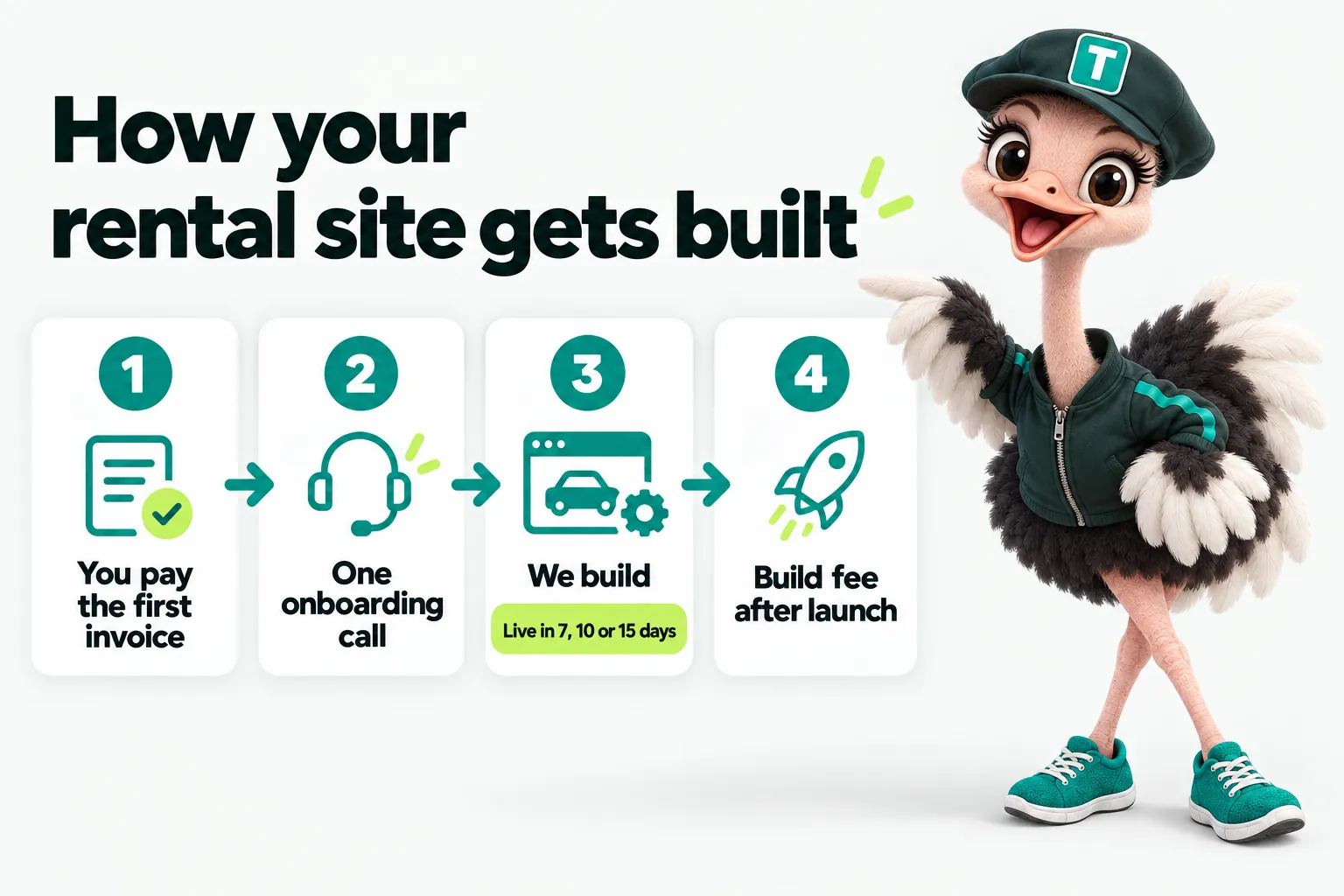
How it works, from invoice to launch
1
You pay the first invoice
That starts the plan. The build fee is not charged yet.
2
One onboarding call
We walk through your fleet, locations and rates, and agree the launch date.
3
We build
Live in 7, 10 or 15 days, depending on the plan.
4
Build fee after launch
Invoiced only once you have approved the finished site.
Work out whether this pays, with your own numbers
We are not going to show you an industry average booking value or a conversion rate lifted from somebody else's business. You already know your numbers, and they are the only ones that matter here.
- 1Your own number
What is one rental worth to you?
Take your average booking value, not a headline day rate: the real figure after the discount you usually give and the days you usually rent for.
- 2Your own number
How many enquiries do you miss in a week?
Count the calls nobody answered, the voicemails nobody returned, and the people who left your site because nothing told them whether you had the class free.
- 3The arithmetic
Multiply the two, then compare it to the plan
A plan starts at $127 a month. If recovering a single booking a week clears that, everything the plan does after that is the same fee.
What is fixed on our side
- $127, $267 plus AI usage, or $647 a month
- $697 build fee, invoiced only after your site is live and approved
- No hosting bill, no domain renewal, no hourly change requests
- No annual contract to sign. Cancellation needs 2 business days notice before your next invoice
Those four lines are the whole cost side. Nothing else appears on an invoice in month four, which is the part most operators have been burned by before.
Three plans, one build fee only after launch
Every plan includes the site, the booking tool, hosting and weekly updates. Tiers add the AI Engine and the Content Engine.
Adds the AI Engine
Multi Lot
Everything, plus the AI Engine
$267/ month + usage
- Live in 10 days
- 2 articles a week
- AI Engine included
All Locations
Everything, plus the Content Engine
$647/ month
- Live in 15 days
- 3 articles a week
- AI Engine included
- Content Engine included
Plus a $697 one-time build fee, invoiced only after your site is live and approved. See the full offer.
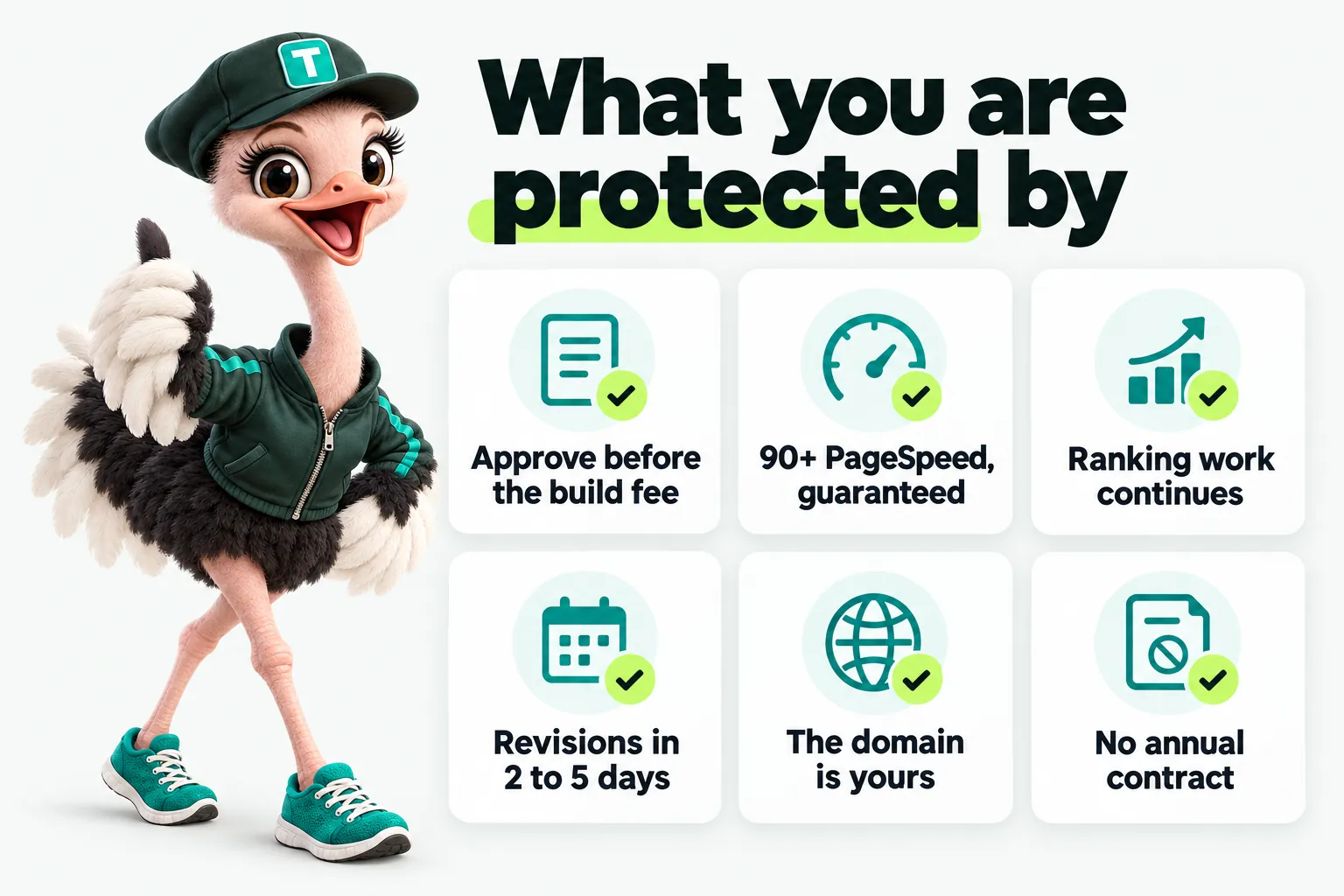
What you are protected by
Every one of these is a published term of the offer, not a sales line. They exist because most operators have been through at least one website build that went the other way.
You see the site before the build fee
The $697 build fee is invoiced only after your site is live and you have approved it. You are never asked to pay for a build you have not seen.
90+ PageSpeed, or we fix it
On mobile and desktop, for pages we build and host. If a page falls short of 90+, fixing it is our cost, not a change request.
Ranking work continues past 3 to 5 months
The class and location structure is built to start ranking locally within 3 to 5 months of launch. If it has not, search work continues at no additional charge until it does.
Every revision inside 2 to 5 working days
5 revisions a month, any size, completed within 2 to 5 working days. After that, a flat $20 each, with no hourly billing anywhere.
The domain is yours, not ours
Registered in your name. If you ever leave, tell us where to send it and we transfer it at no charge rather than holding it.
No annual contract
Plans run month to month. Cancelling takes an email that reaches us at least 2 business days before your next invoice date.
What we do not promise: a booking volume, a search position, or a cost per click. Anyone who puts a number on those for a rental company they have not worked with is guessing. The plan starts at $127 a month and the terms above are what we will hold ourselves to in writing.
What clients tell us
Rental desk leads, coordinators and branch managers on what the site changed for them, in their own words.
I tested the daily vehicle hire page on my own phone before we approved anything. Everything a visitor needs is up top, and the inquiry button stands out properly. The days of talking customers through the menu are over.
We handed over a folder of our real daily vehicle hire replies and let them work from that. Each answer was reviewed by our own staff, so the page sounds like us rather than a copywriter. I now share a link instead of digging through the outbox.
People used to call just to check their daily vehicle hire form had actually gone through. The acknowledgment explains the next step clearly and tells people how to reach us if something is wrong. Duplicate submissions have dropped away almost completely.
The preparation page for daily vehicle hire works because it keeps its focus. People come to the first call prepared, and nobody has been asked to upload anything premature. It has replaced the hurried afternoon rewrite of the same instructions.
Getting the daily vehicle hire wording right mattered more to us than any visual choice. The boundaries are drawn clearly: what the site settles, and what our people still decide. Customers arrive with realistic expectations, which changes the whole tone of the first call.
Daily vehicle hire messages used to belong to everyone, which meant they belonged to no one. Every inquiry arrives with an owner, a status, and the context attached. The website and our way of working finally match.
The old daily vehicle hire PDF made sense on a printer and nowhere else. Each section has its own link, so answering a question no longer means attaching the whole file. Nothing was taken away from the people who like paper.
The audit found our daily vehicle hire details repeated across several pages, each worded slightly differently. There is a single approved version now, owned by a named person with a review date. Customers no longer quote wording we retired two years ago.
The guided contact options looked like a small feature; they changed the inbox. Visitors choose what they are doing first, and each choice leads to a fit-for-purpose form. Returning customers no longer repeat the whole form to ask one question.
Misdirected daily vehicle hire calls were a daily tax before this. The visitor picks their location once, and it follows the message all the way to the reply. Simpler for visitors, and much simpler for whoever covers the phone.
The brief I gave them was simple: demonstrate, do not proclaim. The claims are still there, but now they come with the evidence attached. People comment on it, which never happened with the old page.
A lot of our daily vehicle hire interest arrives after we close; the site finally accepts that. It gathers the right details overnight without pretending anyone is at the desk. Nobody mistakes an automated acknowledgment for an answer, which matters to us.
The daily vehicle hire form used to punish anyone who missed one answer. The messages name the problem, and correcting a field no longer clears the rest. Abandoned half-completed submissions have become rare.
The old daily vehicle hire address sits in hundreds of our sent messages; breaking it was not an option. We reviewed the full redirect map before launch and checked the destinations ourselves. Not one 'your link is broken' message arrived after launch.
Our old change process for daily vehicle hire content was informal to the point of folklore. Every change is recorded as old text, new text, approver, then published from that record. The follow-up email chains that used to accompany every edit have gone.
Our follow-ups on daily vehicle hire used to arrive disguised as brand-new inquiries. Follow-ups reach the right thread quickly instead of starting a duplicate one. Customers are spared a thoroughly unnecessary second introduction.
The reporting for daily vehicle hire is something I can genuinely use. It shows which page an inquiry started on, not merely how many people visited. It establishes honest measurement without pretending to prove results.
We asked about the bad day, not the good one: a failed daily vehicle hire submission. There is now a visible backup route, honest error wording, and a test that proves mail arrives. That attention to the invisible parts of the site gave me confidence in the handover.
What impressed me most was not the daily vehicle hire pages but the handover that came with them. There is a page inventory, update instructions, and named owners with backups. The site survives my vacation now, which it never did before.
Case studies from rental teams
What each team asked for, what we built and what changed, with the person we worked with quoted by name.
- Inquiry forms
First messages worth answering for daily vehicle hire
Automatic-only car rental branch, Overland Park, Kansas
Read the case studyOne message about daily vehicle hire now carries what three used to. The difference shows up every morning.
- Pages and answers
The short path to daily vehicle hire on mobile
Weekend and vacation car rental, Green Bay, Wisconsin
Day to day with daily vehicle hire, the journey from landing page to inquiry now works with a thumb. Staff answering questions on the move have a direct page to point people to.
15 working days - Migration and upkeep
No dead ends: migrating daily vehicle hire properly
Suburban car and MPV rental, Columbia, South Carolina
When it comes to daily vehicle hire, previously shared links now arrive at relevant current information rather than a dead end. The scope protects continuity of access; it does not assume search rankings are unaffected.
20 working days
Where we work
Across the United States, remotely, for car and van rental companies of every size. The build runs on one onboarding call and your client portal, so the state you operate in changes the content of your site, not the way the work happens.
Most of the operators this is built for sit where rental demand concentrates: airport and leisure traffic in Florida, Nevada and Arizona, long distance one way moves out of Texas and North Carolina, dense independent and exotic fleets in California, corporate and passenger van volume around Chicago and Atlanta, cargo and trade vans across Washington, and metro one way rental in and out of New York. If you run a lot somewhere else, nothing about the build changes.
- FLFlorida
- TXTexas
- CACalifornia
- AZArizona
- NVNevada
- GAGeorgia
- NCNorth Carolina
- NYNew York
- ILIllinois
- WAWashington
We do not publish a page per city on this site, and we would tell you not to either. What we do build is a real page for each of your pickup locations, with that lot's hours, directions and the classes actually parked there, which is what a local search is looking for.

The comparison you are already making
Nobody decides this in a vacuum. You are weighing us against a platform you have used before, a freelancer you have worked with, or leaving the site alone for another year. Here is the honest version of each, including where the other option is genuinely the better call.
- GoHighLevel funnelsA funnel converts traffic you pay for. A site earns traffic you do not. Most lots end up wanting both.Read the comparison
- GoHighLevel website builderFine for a simple presence inside the CRM you already pay for. Harder work once you have classes and lots.Read the comparison
- GoHighLevel AI StudioGeneration gets you a draft fast. It does not run your site, write from your fleet, or own the result.Read the comparison
- WordPressEndlessly capable, and endlessly yours to maintain. The plugins are free; the upkeep is not.Read the comparison
- WixQuick, cheap and genuinely fine for one lot. The work is all yours, forever.Read the comparison
- SquarespaceDesign-led and genuinely handsome. Less suited to thirty structured pages nobody has time to maintain.Read the comparison
- WebflowThe best DIY platform for structure, if you have a designer. You are still hiring the work separately.Read the comparison
- GoDaddy Website BuilderThe fastest way to exist online. Rarely the way to be found for anything but your own name.Read the comparison
- Hiring a freelancerGreat for a one-off build or custom work. The gap shows up in month four, when nobody owns it.Read the comparison
- A rental marketing agencyAgencies buy attention across channels. This buys the asset that attention has to land on.Read the comparison
See it built for your fleet, not a stock demo
A 30 minute walk-through of a site built for a business like yours, on your screen, in your colours.
The questions rental operators ask first
What exactly do I get for the monthly fee?
A fully managed, custom-coded website built for your car or van rental operation: fleet and vehicle class pages, a page for every pickup location, a booking request tool that routes into your CRM, weekly updates to your fleet and rate text, 2 researched articles a week, and hosting with SSL, CDN and DDoS protection included. Nothing here is itemised separately.
How long until my site is live?
7 days on Solo Lot, 10 on Multi Lot while the AI Engine is trained on your business, and 15 on All Locations with the Content Engine set up. The clock starts at the onboarding call, not at purchase, so the sooner your fleet list and rates are in, the sooner you are live.
What do I actually pay, and when?
You pay the monthly fee for the tier you choose up front: $127, $267 plus AI usage, or $647 a month. The $697 one-time build fee is invoiced only after your site is live and you are satisfied with it. Domain and hosting are inside the monthly figure.
What happens straight after I buy?
You fill in the onboarding form and submit it. It asks for your fleet, your pickup locations, your rates, your brand and where booking requests should land, and it takes about 15 minutes. If something is missing, submit anyway: you can send the rest by email or raise it as a ticket in your client portal, and it will not hold up the build. We then run one onboarding call to fill any gaps and agree the launch date.
What does the AI Engine actually do for a rental business?
On Multi Lot and above, an AI receptionist and site chat answer common questions: which locations carry a vehicle class, whether one way drop-off is available, and how to start a booking request. It is configured to hand anything about a specific reservation or a policy exception to your team rather than guessing, and it never quotes a rate it has not been given.
What do you actually do for search?
One target search per page, mapped across your vehicle classes, your pickup locations and the policy questions renters type, before anything is written. Titles, descriptions, headings and internal links are written page by page, structured data is generated per page type, and 2 researched articles a week keep the site publishing. If your class and location pages have not started ranking locally within 3 to 5 months of launch, search work continues at no additional charge until they do.
Is this a booking marketplace that lists my vehicles alongside other rental companies?
No. This is your own website, built for your business only. Your fleet, your rates and your branding are the only ones shown, and nothing is shared with or listed alongside a competing operator.
How do I cancel, and how much notice do you need?
Email us and say you want to cancel. Your message must reach us at least 2 business days before your next invoice date, during business hours, which are 9:00 to 17:00 Central Time, Monday to Friday. A message sent outside those hours counts from the start of the next business day, so a weekend email does not give 2 business days of notice for an invoice due Monday or Tuesday. With valid notice, no further invoice is raised and your site runs to the end of the month you have paid for. With late notice, the next invoice is charged as normal and the cancellation takes effect at the end of that month.
Ready to see it built for your lot?
Plans from $127 a month, plus a $697 build fee invoiced only after launch. Live in 7 days.